
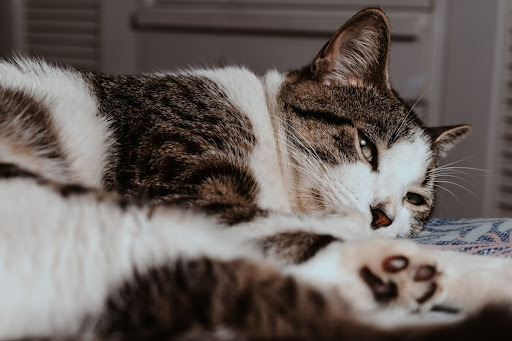
If you’re asking yourself how to tell if my cat is in pain, you’re not overthinking it. You’ve noticed something has shifted, and with cats, that “something” is often quiet.
Pain in cats rarely looks like a dramatic limp or constant crying. More often, it shows up as small changes in behaviour, movement, and routine that are easy to explain away. Many cats will still eat, still purr, and still come for a fuss, while quietly adapting to discomfort.
In appointments, we often find the earliest clue is a change in jumping, grooming, or tolerance of touch rather than anything obvious. What matters most is the pattern over time, not a single “good day” that makes everything seem fine again.
Why cats often hide pain
Cats tend to hide discomfort, so small changes often mean more than they seem. In the wild, an obvious weakness could make an animal vulnerable, and that instinct doesn’t disappear just because home is safe.
Instead of telling you directly, cats often cope by:
- Moving less, but not stopping entirely
- Avoiding certain jumps or positions
- Resting in tighter, guarded postures
- Becoming less tolerant of handling
Because these changes can happen gradually, it’s easy to miss them until your cat’s “new normal” becomes uncomfortable.
Acute vs chronic pain in cats
Understanding whether the change feels sudden or gradual can help you describe what you’re seeing.
| What you might notice | Acute pain (sudden) | Chronic pain (gradual) |
| Onset | Appears quickly | Builds over weeks or months |
| Movement | Reluctant to move, guarding | Less jumping, stiffness, slowing down |
| Mood | Sudden withdrawal or reactivity | Quieter, less playful, less social |
| Routine | Quick shift in habits | Subtle changes that creep in |
| Handling | Clear sensitivity in one area | Lower tolerance overall |
Chronic pain is the one that catches people off guard. Cats are very good at adjusting, and those adjustments can be the clue.
The signs your cat may be in pain
Pain usually shows up across three areas: behaviour, movement, and everyday habits. One sign alone doesn’t confirm anything, but several changes together are worth acting on.
Behaviour changes
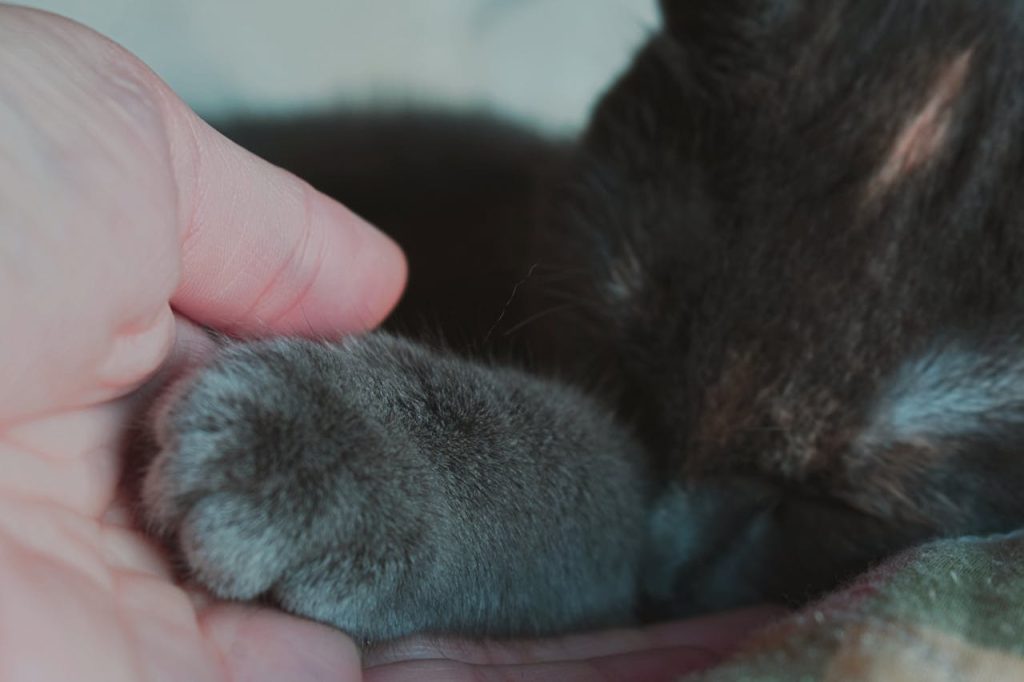
This is often the earliest clue. Watch for:
- Hiding more than usual, or choosing unusual resting spots
- Less interest in play, fuss, or family time
- Becoming clingy or unusually needy
- Irritability, growling, hissing, swiping, or biting when approached
- A sudden reluctance to be picked up or stroked
If your cat has become sharper when handled, pain should be on your list before you assume it’s behavioural.
Movement and posture changes
Cats are built for confident movement. When that confidence fades, it matters.
Look for:
- Hesitation before jumping, or choosing lower routes
- Using furniture as stepping stones instead of one clean leap
- Stiffness after resting, especially on waking
- Slower walking, smaller steps, or a “careful” gait
- A hunched posture, tucked belly, or tightly held body
A helpful cross-check is whether these changes overlap with broader illness patterns. If you want a wider lens on what “something isn’t right” can look like, our guide on how to know if your cat is ill can help you spot other signs worth discussing.
Facial tension (the “pain face”)
Cats can show pain in their facial expression, even if they’re not vocal. You might notice:
- Squinting or half-closed eyes
- Ears held back or flattened
- A tense muzzle
- Whiskers held stiffly or positioned oddly
There’s solid research behind this. The paper on the development and validation of the Feline Grimace Scale explains how facial features can change with pain and improve following analgesia, supporting the idea that facial tension can be a meaningful sign.
You don’t need a scoring system at home. Noticing change is enough.
Grooming and coat changes
Grooming shifts can be a quiet alarm bell:
- Some cats overgroom one area (often where it hurts)
- Others stop grooming, leading to a scruffy coat, dandruff, or mats
- You may notice sensitivity during brushing, especially along the back or hips
Overgrooming can also be stress-related, so look at the wider pattern, not just one habit.
Litter tray changes
Pain can make toileting uncomfortable or awkward, especially if getting into the tray or posturing is difficult.
Watch for:
- Avoiding the tray or hesitating at the entrance
- Straining, frequent trips, or discomfort while toileting
- New accidents outside the tray
These changes can have several causes, but they should never be ignored.
Common sources of pain in cats
You won’t be able to identify the cause at home, and you don’t need to. Still, it helps to know that pain often comes from everyday issues we see frequently in practice.
Common sources include:
- Dental disease and mouth pain
- Arthritis and joint disease
- Urinary tract discomfort
- Gastrointestinal pain
- Wounds, abscesses, or bite injuries
- Ear problems and inflammation
If you’re seeing signs and you’re not sure what’s driving them, that uncertainty is normal. It’s one of the reasons a gentle veterinary assessment can be so helpful.
Why eating (or purring) doesn’t rule out pain
A common misconception is that if a cat is eating, they must be fine. Appetite is not a reliable measure of comfort. Some cats will keep eating while they:
- Stop playing
- Move less
- Avoid jumping
- Hide more often
- React defensively to touch
Purring can be misleading, too. Cats purr when content, but they can also purr when anxious or uncomfortable. It’s not a guarantee of comfort.
What you can do at home without making things worse
You don’t need to diagnose your cat. Your job is to observe safely and gather useful information.
A simple approach that helps in a consultation:
- Watch movement naturally – getting up, jumping, walking, using steps
- Note behaviour patterns – hiding, play, interaction, tolerance of touch
- Check daily routines – grooming, toileting, sleep, appetite, posture
- Avoid forcing a hands-on exam – if your cat may scratch or bite, don’t push it
If you want to be genuinely helpful, write down what you’ve noticed over a few days:
- What changed first
- When it started
- What seems to make it worse (jumping, brushing, being lifted)
- Whether it’s improving, stable, or gradually worsening
A simple timeline helps us assess what’s going on far more quickly. Avoid giving any medication unless a vet has specifically prescribed it for your cat.
When pain is urgent
Some signs shouldn’t wait, even if you’re not sure of the cause.
Seek urgent veterinary advice if your cat:
- Collapses, can’t stand, or is suddenly very weak
- Has difficulty breathing
- Cries out, can’t settle, or seems distressed for a prolonged period
- Has a swollen abdomen or looks acutely uncomfortable
- Stops using a limb or appears suddenly unable to move normally
- Deteriorates rapidly over hours rather than days
If you’re unsure whether it’s urgent, it’s safer to ask. The PDSA advice on recognising severe pain in pets reinforces that severe pain can signal a serious problem even when the cause isn’t obvious.
What happens when we assess a cat for pain
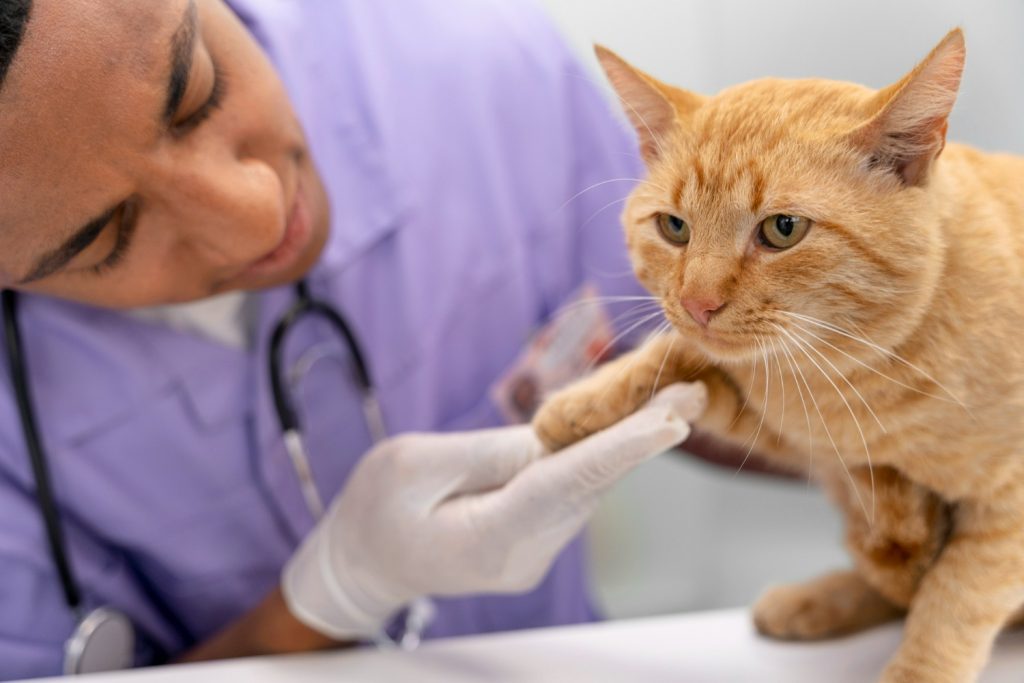
When someone tells us, “I think my cat is in pain,” we take it seriously, even if the signs seem subtle. We also take a low-stress approach to handling and assessment, particularly when a cat is anxious or uncomfortable.
A veterinary assessment usually involves:
- Listening carefully to what’s changed at home
- Observing posture, movement, and responsiveness
- A gentle examination, focusing on likely sources of discomfort (joints, spine, abdomen, mouth, ears)
- Discussing sensible next steps, which might include pain relief, diagnostics, or management planning
If you’re unsure whether your observations warrant a visit, our contact page makes it easy to reach the team for advice.
When comfort becomes the focus
Most pain has options. The earlier we recognise it, the more we can usually do to improve comfort and quality of life.
But sometimes pain becomes persistent despite support, and families begin thinking about what “kindness” looks like now. For cats who are most settled at home, our home euthanasia service can provide a gentle goodbye in familiar surroundings.
If your cat’s comfort is declining and you want to understand the kindest options without pressure, visit the home euthanasia page and reach out when you’re ready to talk.
In summary
Cats rarely announce pain. They hint at it. Less jumping. More hiding. A change in grooming. A shorter fuse. A quieter life that creeps in gradually.
If you’re noticing a pattern, trust what you’re seeing. The sooner pain is recognised, the sooner we can support your cat’s comfort and wellbeing in a calm, thoughtful way.